

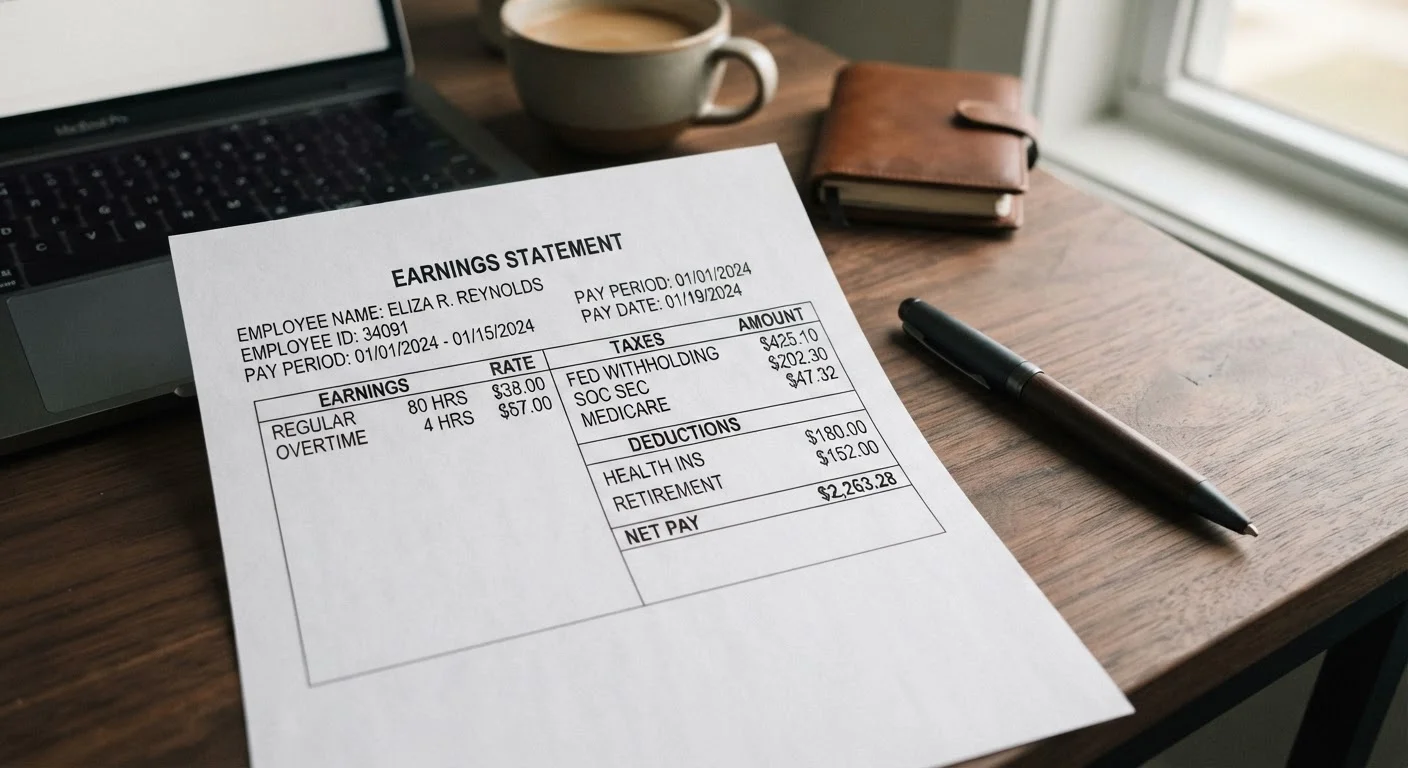
Why Your Pay Stub Is Worth Reading Carefully
Most workers glance at one number - the deposit amount - and move on. But your pay stub is a compact financial document that records your earnings, deductions, and benefits contributions in one place. Reading it carefully helps you catch errors, understand your tax withholding, and verify that your employer is deducting what they said they would.
Learning to decode a pay stub is a practical skill with immediate payoff. Just as decoding a vehicle's window sticker helps you evaluate a car purchase (see how to read a Monroney sticker), reading a pay stub helps you evaluate the real value of a job offer and track your income accurately over time.
The Core Sections Explained
Gross Pay
Gross pay is your total earnings before any deductions. For salaried workers, this is your annual salary divided by the number of pay periods. For hourly workers, it reflects hours worked multiplied by your hourly rate, plus any overtime. Gross pay is the starting figure from which everything else is calculated.
Net Pay
Net pay - sometimes labeled "take-home pay" - is what actually lands in your bank account. It equals gross pay minus all deductions. A significant gap between gross and net is normal once taxes and benefits are factored in.
Federal and State Income Tax Withholding
These lines show how much your employer has withheld on your behalf to cover federal and state income tax obligations. The amount depends on your gross pay and the withholding instructions you provided on your W-4 form when you were hired. Withholding too little means a tax bill in April; withholding too much means a refund. You can update your W-4 at any time.
FICA Taxes
FICA stands for the Federal Insurance Contributions Act. It covers two separate taxes:
- Social Security tax - a fixed percentage of wages up to an annual earnings cap set by the IRS each year.
- Medicare tax - a fixed percentage of all wages, with an additional surcharge for higher earners.
Your employer matches these contributions dollar-for-dollar, though that match does not appear on your stub.
Pre-Tax Deductions
These reduce your taxable gross pay before income and FICA taxes are calculated, lowering your overall tax burden. Common examples include contributions to a 401(k) or 403(b) retirement plan, health insurance premiums, dental and vision coverage, and contributions to a Health Savings Account (HSA) or Flexible Spending Account (FSA).
Post-Tax Deductions
These are taken after taxes are calculated and do not reduce your taxable income. Examples include Roth 401(k) contributions, certain life insurance premiums, and wage garnishments ordered by a court.
Year-to-Date (YTD) Totals
YTD columns show the running cumulative totals for each line since January 1 of the current tax year. These figures are especially useful for verifying your W-2 at tax time and for tracking how close you are to contribution limits for retirement accounts.
Gross Pay
Total earnings before any taxes or deductions are removed. This is the baseline figure from which all calculations start.
Net Pay
The amount deposited into your account after all deductions. Also called take-home pay.
FICA
Federal Insurance Contributions Act. Covers mandatory Social Security and Medicare taxes split between employee and employer.
W-4 Form
An IRS form employees complete to tell their employer how much federal income tax to withhold from each paycheck.
Pre-Tax Deduction
A deduction taken before income taxes are calculated, reducing the amount of wages subject to tax.
Year-to-Date (YTD)
A cumulative total of earnings or deductions from the start of the current calendar year through the current pay period.
HSA
Health Savings Account. A pre-tax account paired with a high-deductible health plan used to pay qualified medical expenses.
FSA
Flexible Spending Account. A pre-tax account for health or dependent care expenses, typically with a use-it-or-lose-it annual rule.
The content on this site is provided for informational purposes only and should not be considered a substitute for professional advice. While we strive to provide accurate and up-to-date information, we make no guarantees regarding its completeness or accuracy. Always consult a qualified professional for advice specific to your circumstances before making any decisions.