

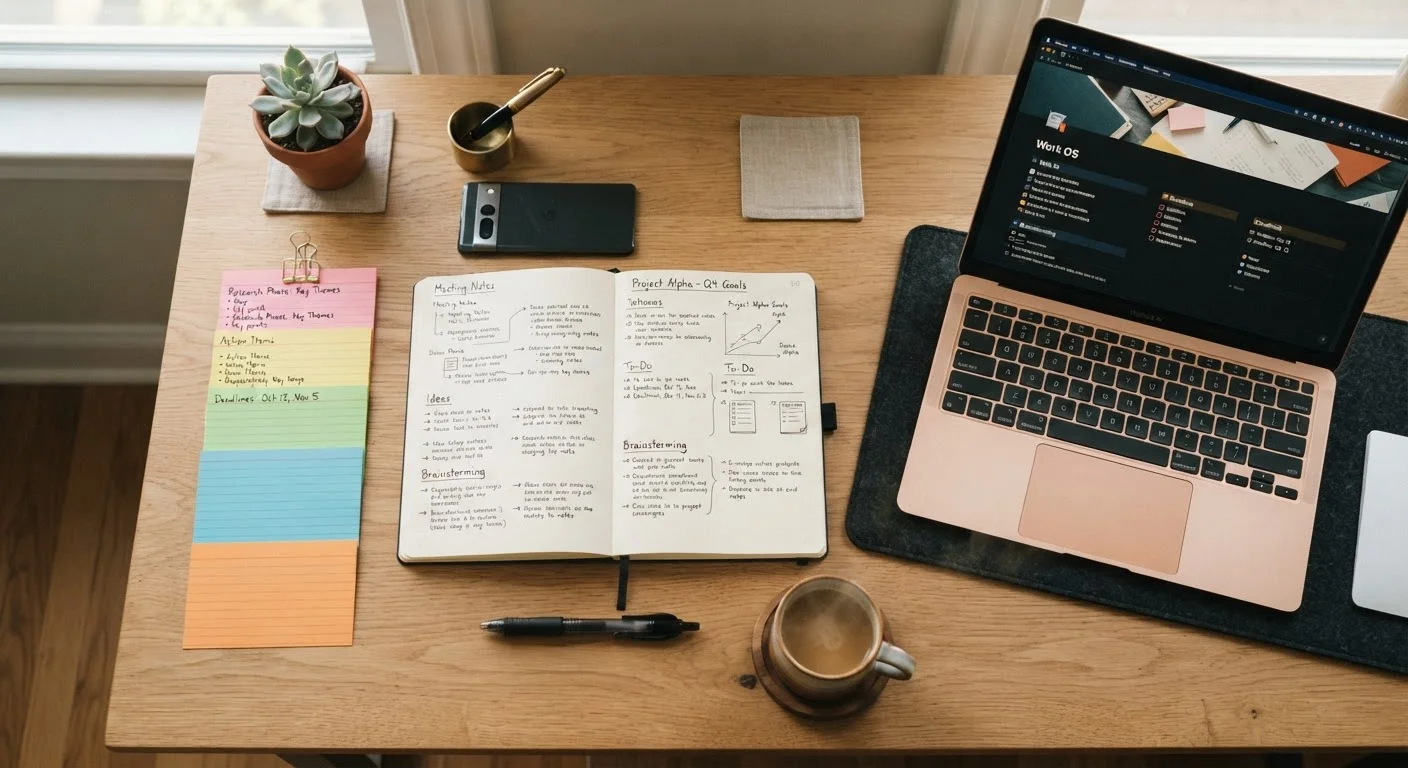
What Is a Personal Knowledge System?
A personal knowledge system (PKS) is any intentional method you use to capture, organize, and retrieve information so it remains useful over time. It's the difference between reading something interesting and actually being able to apply it weeks later - a gap most people know all too well.
The concept isn't new. Writers, scientists, and researchers have kept structured notebooks for centuries. What's changed is the volume of information competing for your attention and the variety of tools available to manage it. As explored in our article on what research says about adult learning, adult learners face real cognitive constraints - time pressure, working memory limits, and competing responsibilities. A well-structured PKS directly addresses these challenges.
A good system has three layers: capture (getting information in), consolidation (making it memorable), and retrieval (finding and applying it when needed). Most people only practice the first layer and wonder why nothing sticks.
Capturing Information Without Drowning in It
Effective capture is selective, not comprehensive. The goal isn't to archive everything - it's to save what you'll genuinely use. A practical rule: if you wouldn't reread a note within three months, it probably doesn't need to be saved at all.
Choose one primary capture tool and use it consistently. Whether that's a physical notebook, a simple app, or a voice memo, friction is the enemy of habit. When capture is effortless, it happens. When it requires switching between five apps, it doesn't.
When you finish reading an article or chapter, close it and write a two-sentence summary from memory before checking what you missed. That retrieval attempt - even an imperfect one - does more for retention than any amount of re-reading.
Cognitive science consistently shows that the act of attempting recall, rather than passively reviewing, strengthens memory consolidation - a principle known as the testing effect.
Limit your capture tool to one primary location. Every additional app or notebook you add creates a decision about where to look, which quietly erodes your willingness to use the system at all.
Behavioral research on habit formation indicates that reducing friction - the number of steps or decisions required - is one of the strongest predictors of whether a new behavior persists.
Structure your notes at the point of capture rather than planning to organize them later. A brief header - the source, the date, and one sentence on why it matters to you - takes ten seconds and saves hours of confused archaeology later. This is particularly relevant if you're building a self-directed study plan, where notes accumulate rapidly without a course syllabus to organize them.
Using Spaced Repetition to Make Learning Stick
Spaced repetition is a research-backed study technique in which you review material at gradually increasing intervals - reviewing a concept after one day, then three days, then a week, then a month. Each review reinforces the neural pathway before it fades, dramatically improving long-term retention compared to re-reading or highlighting alone.
~10%
Information retained after one week without review
Memory research consistently estimates that without deliberate review, most people retain only a fraction of new material after seven days - a finding associated with the Ebbinghaus forgetting curve model.
2x+
Retention improvement with active recall vs. re-reading
Multiple studies in cognitive psychology, including work reviewed in journals such as Psychological Science, find that retrieval practice produces substantially stronger long-term retention than passive review strategies.
You don't need specialized software to apply this principle. A simple index-card system or a divided notebook works. Mark cards or entries by review date, and briefly test yourself - not just read - each time you return to them. That act of retrieval (forcing yourself to recall before checking) is what creates durable memory, not passive review.
This aligns with advice in our overview of habits that help online learners succeed: active recall and realistic scheduling separate learners who retain knowledge from those who feel like they studied but remember little.
Building and Applying Mental Models
Mental models are frameworks for understanding how things work - simplified representations of complex systems that help you reason and make decisions. Examples include first-principles thinking (breaking a problem down to its foundational truths), the Pareto principle (roughly 80% of effects come from 20% of causes), and opportunity cost (every choice has a trade-off).
Unlike isolated facts, mental models are transferable. Once you understand opportunity cost, you apply it to budgeting, time management, career decisions, and countless other domains. Building a small library of these frameworks - perhaps ten to twenty that you genuinely understand - pays compounding dividends over a lifetime of decisions.
Record mental models in a dedicated section of your PKS with a plain-language definition and at least one real example from your own life. Revisit them periodically and ask: where did I see this pattern recently? That habit is the difference between knowing a concept and actually internalizing it. For a useful comparison of how structured versus informal learning develop this kind of deep knowledge differently, see our article on formal vs. informal learning.
Maintaining the System Over Time
The most common failure mode for any personal knowledge system is abandonment. People invest effort in setting it up, use it intensively for a few weeks, then let it languish as an overwhelming archive they feel guilty about not using.
The antidote is a brief, regular review - fifteen to twenty minutes once a week. During this session, you process any unorganized captures, schedule spaced-repetition reviews, and scan recent notes for connections you may have missed. Think of it as tending a garden rather than building a monument.
Research on habit formation shows that attaching a new behavior to an existing routine dramatically improves consistency. Pair your weekly review with something already fixed in your schedule - Sunday morning coffee, a Monday lunch break - and it becomes self-sustaining over time.
One final lever: align your review sessions with your personal cognitive rhythms. Our piece on when memory works best explains how retrieval is more effective during certain windows of the day - scheduling reviews during your peak cognitive hours is a small adjustment with measurable results.
A personal knowledge system isn't a productivity accessory. It's a long-term investment in your ability to think clearly, learn continuously, and act on what you know.
The content on this site is provided for informational purposes only and should not be considered a substitute for professional advice. While we strive to provide accurate and up-to-date information, we make no guarantees regarding its completeness or accuracy. Always consult a qualified professional for advice specific to your circumstances before making any decisions.