

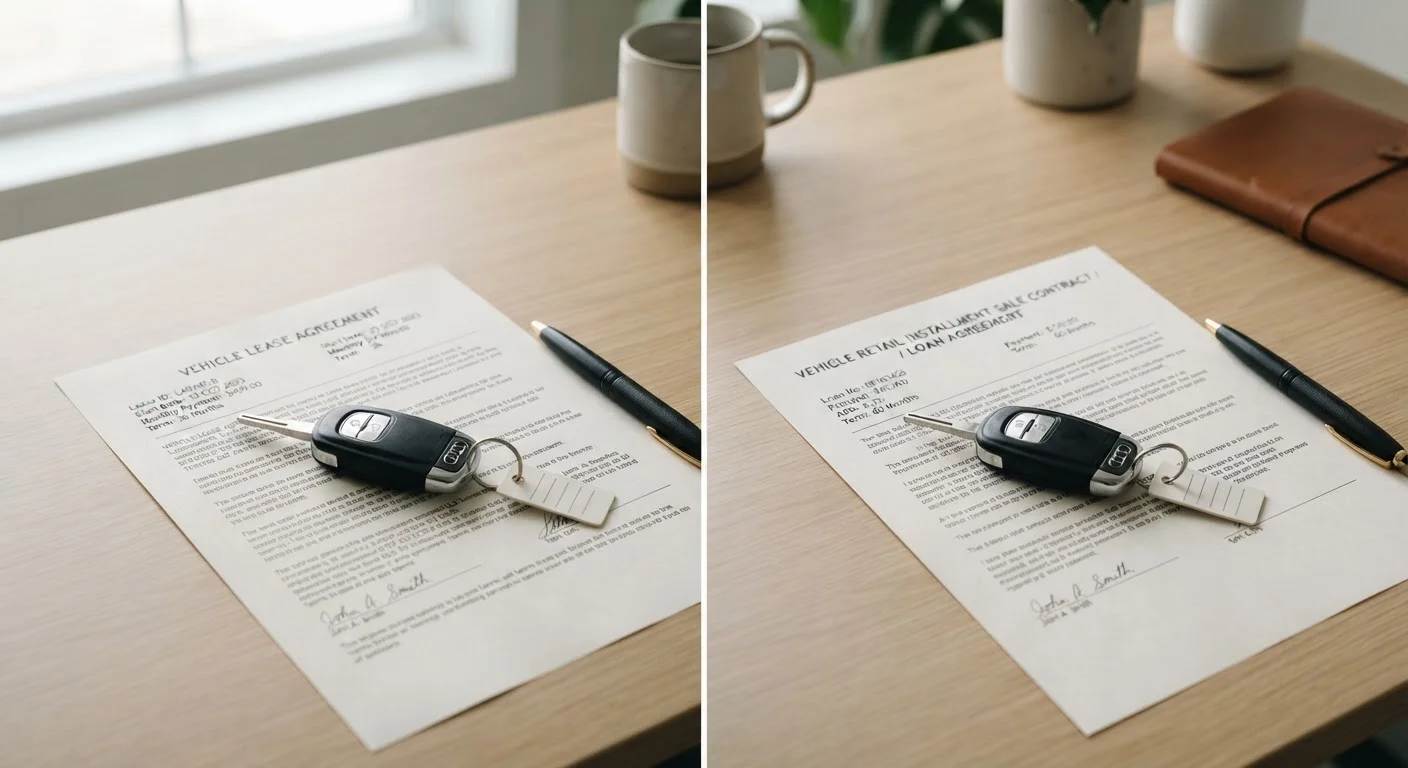
Option A
Leasing
The lower-payment, shorter-commitment path.
Best for: Drivers who want a new vehicle every few years, drive predictable mileage, and prefer lower monthly payments over long-term equity.
Option B
Financing
The ownership-building, long-term value approach.
Best for: Drivers who want to build equity in a vehicle, drive high mileage, or plan to keep the car well past the loan payoff date.
Two Contracts, Two Very Different Realities
The moment you sign either a lease or a loan and pull out of the lot, you've entered a fundamentally different legal and financial relationship with that vehicle. Both put you behind the wheel of a car you didn't pay for outright - but what you can do with that car, what it costs you over time, and what happens when your contract ends are night-and-day different.
A lease is essentially a long-term rental agreement. You're paying for the vehicle's depreciation during your contract period - typically two to four years - plus interest and fees. The automaker's financing arm or a lender retains ownership the entire time. A finance agreement (auto loan), by contrast, transfers ownership to you from day one, with the lender holding a lien until you pay off the balance. Understanding that distinction shapes every practical decision that follows. For a broader look at what vehicle costs accumulate beyond the sticker price, see the full cost of owning a car.
| Criterion | Leasing | Financing |
|---|---|---|
| Ownership | Lessor retains title throughout | Buyer owns; lender holds lien until paid |
| Mileage limits | Typically 10,000-15,000 miles/year | No cap; drive as much as needed |
| Monthly payment | Generally lower for same vehicle | Generally higher; builds equity |
| Equity at end of term | None - return or buy at residual | Full ownership; asset to sell or keep |
| Early exit flexibility | Heavy penalties common | Sell or refinance; more flexible |
| Customization | Prohibited or must be reversed | Permitted within legal limits |
| Insurance requirements | Higher minimums; gap often required | Required while lienholder active; more flexible later |
| Wear-and-tear accountability | Fees charged at return | Affects resale value, not penalties |
Mileage, Wear, and the Hidden Costs of Leasing
One of the most consequential post-signing realities for lessees is the mileage cap. Most leases allow between 10,000 and 15,000 miles per year. Go over, and you'll typically owe 10-25 cents per excess mile at turn-in - an amount that adds up quickly. A driver who exceeds their cap by 5,000 miles in a 36-month lease could face a bill of $750 to $1,875 at return.
Beyond miles, leases impose wear-and-tear standards. Scuffs on alloy wheels, a cracked windshield, stained upholstery, or even tires below a specified tread depth can trigger charges. Most leasing companies define "normal" wear narrowly. If you have children, pets, or a job that involves hauling tools or materials, those realities can translate directly into fees at turn-in.
Financed vehicle owners face none of those penalties. You can put 25,000 miles a year on a car you own and face only the increased maintenance and depreciation costs common to any high-mileage vehicle. That freedom has real value, especially for drivers who commute long distances or use a personal vehicle for work. Urban drivers in particular may want to weigh this alongside the practical pressures covered in owning a car in a big city.
Equity, Flexibility, and What Happens at the End
The starkest long-term difference between leasing and financing is equity. Every loan payment chips away at what you owe on an asset you'll eventually own outright. When the loan term ends, you hold a title - a tangible asset you can sell, trade, or keep payment-free for years. Many financial planners describe paying off a vehicle and continuing to drive it as one of the most effective ways to reduce personal transportation costs over time.
With a lease, your payments cover depreciation and profit for the lessor, not ownership. At term's end, you hand the keys back and start over - either signing another lease, buying the vehicle at a predetermined residual price, or walking away. There's no accumulated asset, and the cycle of payments continues.
Flexibility mid-contract also differs significantly. Selling or trading a financed vehicle is straightforward - pay off the lien and you're done. Exiting a lease early typically involves substantial early termination fees, often amounting to several months of remaining payments. Life changes - a new job, a growing family, a move - can make that inflexibility genuinely costly.
For drivers who want to understand the ownership documents that come with a financed vehicle, vehicle titles, liens, and transfers explained covers what to expect from the paperwork side of things.
Insurance, Customization, and Day-to-Day Differences
Lessors nearly always require higher insurance coverage levels than what state minimums or a typical loan requires. Gap coverage - which covers the difference between what your insurer pays and what you owe if the car is totaled - is often mandatory under a lease. That requirement adds to your monthly costs in ways that may not be immediately obvious when comparing payment amounts.
Financed vehicle owners still need appropriate coverage, particularly while a lien is active, but typically have more flexibility to adjust deductibles and coverage tiers as the car's value decreases. Compare your loan terms carefully - for a clear look at how lender requirements differ, see financing through a dealership vs. your own bank.
Customization is another underappreciated difference. Financed vehicles are yours to modify within legal boundaries - aftermarket wheels, a tow hitch, a roof rack, window tint. Leased vehicles must typically be returned in their original configuration, making most modifications impractical or outright prohibited.
Regular maintenance obligations apply under both arrangements, but lessees have additional incentive to stay current: skipped services can constitute a lease violation and be cited as a wear-and-tear issue at return. A strong maintenance routine matters either way - the car maintenance hub is a useful reference for keeping any vehicle in contract-compliant and roadworthy condition.
This article is intended for general informational purposes only. Lease terms, financing agreements, insurance requirements, and regulatory rules vary by lender, state, and individual contract. Consult qualified financial and insurance professionals before making vehicle financing decisions.
The content on this site is provided for informational purposes only and should not be considered a substitute for professional advice. While we strive to provide accurate and up-to-date information, we make no guarantees regarding its completeness or accuracy. Always consult a qualified professional for advice specific to your circumstances before making any decisions.