

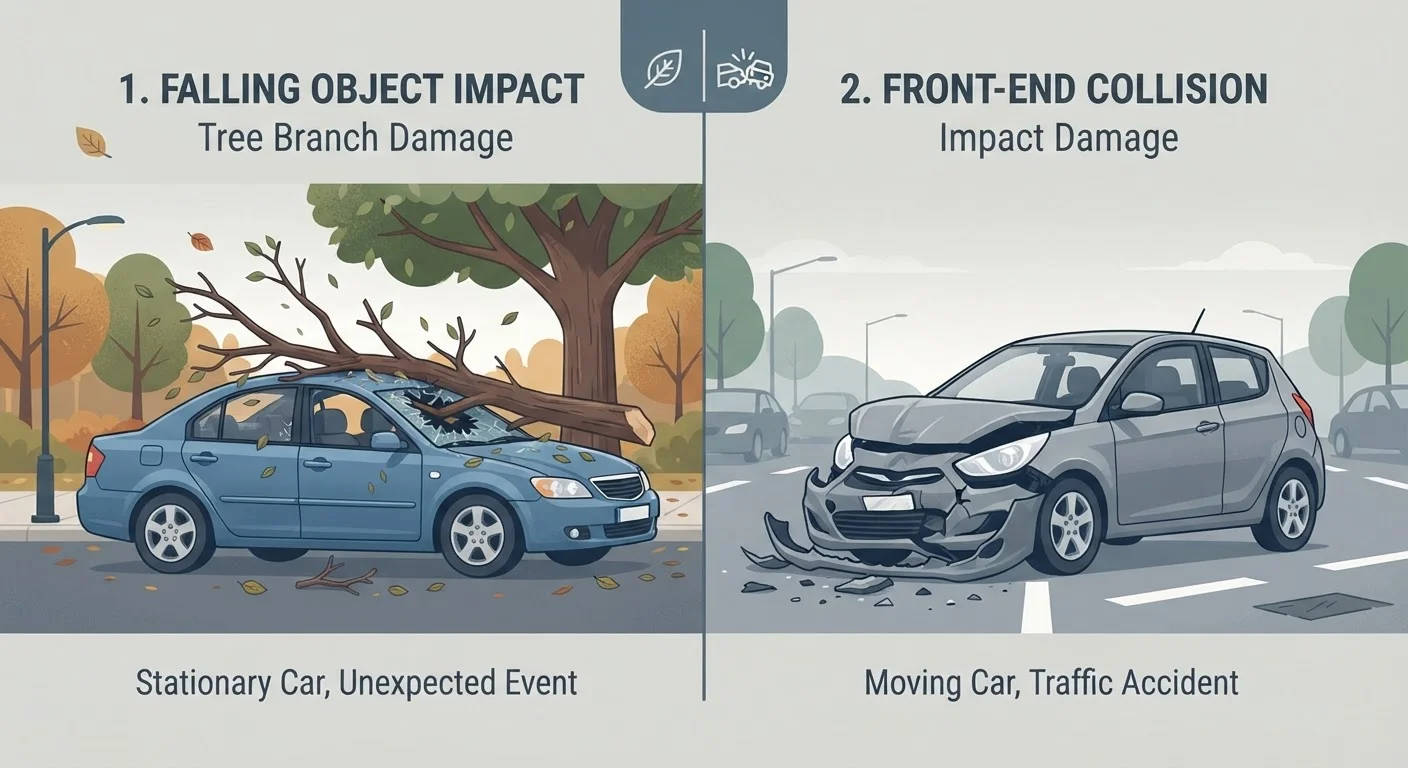
Option A
Comprehensive Insurance
Protection against events outside your control.
Best for: Drivers who want coverage for theft, weather events, animal strikes, and other non-collision incidents.
Option B
Collision Insurance
Coverage for damage caused by impact.
Best for: Drivers who want repair or replacement coverage when their vehicle strikes another car, object, or surface.
Why the Confusion Exists
Most drivers know they need car insurance, but far fewer can explain what comprehensive and collision actually cover - or where one ends and the other begins. The confusion is understandable: both are optional physical damage coverages that appear together on a policy, both carry a deductible, and both pay to repair or replace your vehicle. But the trigger event for each is entirely different, and mixing them up can leave drivers surprised when a claim is denied.
For a fuller picture of how these coverages fit alongside liability, uninsured motorist, and other policy components, see our guide to every auto insurance coverage type.
| Criterion | Comprehensive Insurance | Collision Insurance |
|---|---|---|
| What triggers a claim | Non-collision events (theft, weather, animals, fire) | Physical impact with another vehicle or object |
| Fault requirement | Not applicable - fault is irrelevant | Pays regardless of who is at fault |
| Deductible applies | Yes | Yes |
| Required by lenders/lessors | Typically yes | Typically yes |
| Covers theft | Yes | No |
| Covers hitting a deer | Yes | No |
| Covers hitting a guardrail | No | Yes |
| Generally lower premium of the two | Often yes | Often more expensive |
What Comprehensive Insurance Actually Covers
Despite its name, comprehensive insurance is not a catch-all. It covers damage to your vehicle caused by events that are generally outside the driver's control and not the result of a driving collision. Common covered events include:
- Theft or attempted theft
- Vandalism
- Hail, flooding, or windstorm damage
- Falling objects such as tree limbs
- Fire
- Animal strikes - hitting a deer, for example
- Broken or cracked windshield (in many policies)
What it does not cover: damage from hitting another vehicle, running into a guardrail, or rolling your car. Those events belong to collision coverage. Comprehensive also does not cover personal belongings stolen from inside the vehicle - that typically falls under a homeowners or renters policy.
What Collision Insurance Actually Covers
Collision insurance pays to repair or replace your vehicle when it sustains damage from a physical impact - regardless of who is at fault. Covered scenarios include:
- Hitting another vehicle
- Being hit by another vehicle
- Striking a stationary object such as a guardrail, pole, or wall
- A single-vehicle rollover
One important nuance: if another driver hits you and is clearly at fault, their liability coverage may pay for your repairs. But if they're uninsured, underinsured, or fault is disputed, your own collision coverage becomes the reliable fallback - you pay your deductible and let your insurer sort out subrogation on the back end.
It's also worth understanding that collision and comprehensive together are what most people mean when they say "full coverage" - a term that has no standard industry definition. Our article on why full coverage isn't always what drivers expect explains the gaps that phrase can obscure.
Deductibles, Premiums, and the Math of Keeping or Dropping Coverage
Both coverages require you to select a deductible - the amount you pay out of pocket before your insurer covers the remainder. Common deductible amounts range from $250 to $1,500. Choosing a higher deductible lowers your premium but increases your exposure at claim time.
~$170/yr
Average U.S. comprehensive premium
According to the National Association of Insurance Commissioners, average expenditure on comprehensive coverage in recent policy years has hovered near this figure, though rates vary significantly by state and driver profile.
~$290/yr
Average U.S. collision premium
NAIC data indicates collision coverage consistently carries a higher average premium than comprehensive, reflecting the greater frequency of collision-related claims.
1 in 88
Odds of a vehicle theft claim
The Insurance Information Institute estimates roughly one in 88 comprehensive policyholders files a theft-related claim in a given year, illustrating why location matters when evaluating this coverage.
A commonly cited rule of thumb: if the annual cost of a coverage plus its deductible exceeds roughly 10% of the vehicle's current actual cash value (ACV), it may no longer be cost-effective to carry. Actual cash value reflects depreciation, not replacement cost, so older vehicles lose insurable value quickly. That said, this is a general heuristic - your risk tolerance, local theft rates, and driving environment should all factor into the decision.
This article is for general informational purposes and does not constitute insurance or financial advice. Coverage availability, terms, and costs vary by insurer, state, and individual circumstances. Consult a licensed insurance professional for guidance specific to your situation.
The content on this site is provided for informational purposes only and should not be considered a substitute for professional advice. While we strive to provide accurate and up-to-date information, we make no guarantees regarding its completeness or accuracy. Always consult a qualified professional for advice specific to your circumstances before making any decisions.