

Start here
Why Japan Rewards First-Time Visitors
Core skill
Understanding the Rail System Before You Land
Go deeper
Getting Around Within Cities
Cultural prep
Street-Level Etiquette and Unwritten Rules
Final checklist
Practical Essentials Before You Arrive
Why Japan Rewards First-Time Visitors
Japan has a way of exceeding expectations quietly. The country doesn't announce itself with dramatic first impressions - it reveals itself gradually through clean train cars arriving on the exact second, vending machines tucked into mountain trails, and the unexpected warmth of a convenience store clerk who draws you a hand-sketched map when you're lost.
For first-time international travelers, Japan is an unusually forgiving destination. Infrastructure is exceptional, streets are generally safe to navigate at night, and the culture places a high value on helping visitors. If you're still building your international travel confidence, our first international trip primer covers the foundational logistics - passports, visas, and budgeting - before you think about booking flights.
That said, Japan's systems are deeply structured. Coming in with basic knowledge of how trains, payments, and social norms work will make your first week dramatically smoother.
Understanding the Rail System Before You Land
Japan's rail network is genuinely world-class, but it's also layered. Multiple operators - including JR (Japan Railways), private lines, and metro systems - run overlapping routes that can look intimidating on a map. The good news: the logic becomes readable quickly once you understand the basics.
Load Your IC Card at the Airport
Suica cards can now be added to Apple Wallet or Google Pay before you even land, letting you tap through gates from your very first train ride. If you prefer a physical card, kiosks at major airports have English-language interfaces. Either way, load enough yen to cover your first day of transit without hunting for a top-up machine while jet-lagged.
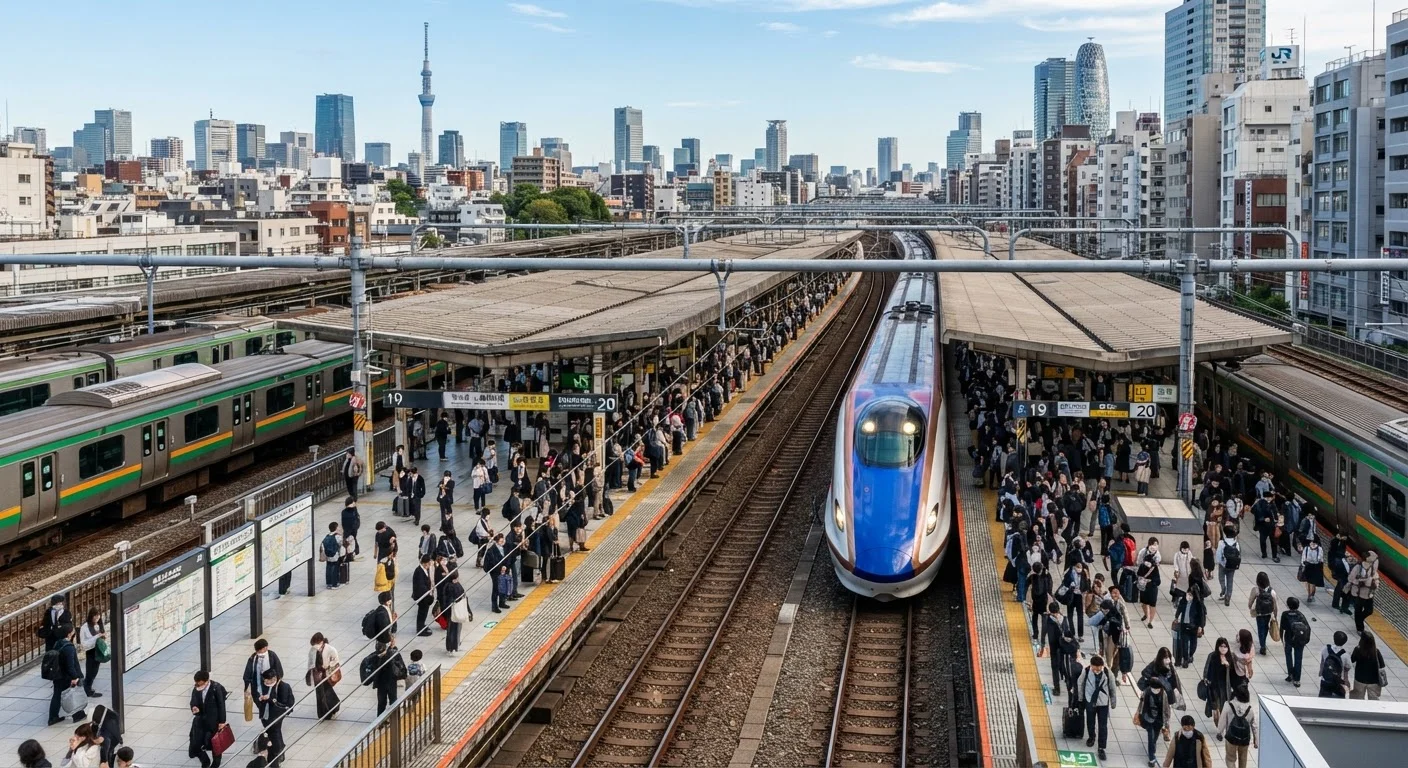
The Shinkansen (bullet train) connects major cities at speeds up to 320 km/h (~200 mph) and runs with extraordinary punctuality. For intercity travel, it's the backbone of most itineraries. The IC card - sold under regional names like Suica (Tokyo) or ICOCA (Osaka/Kyoto) - is a rechargeable card that works on most urban rail, subway, and bus systems nationwide. Load it up and tap in and out without purchasing individual tickets for every ride.
Navigation apps like Google Maps and the Japan-specific Navitime handle multi-operator routing well and display platform numbers. Download one before landing. For deeper orientation skills in unfamiliar transit systems, our guide on navigating unfamiliar cities offers proven strategies that apply directly here.
Getting Around Within Cities
Within cities, trains and subways handle most of what you need. Tokyo's subway system is dense but well-labeled in English. Kyoto relies more on buses, which use a flat-fare system within the city center. Osaka's metro is among the easiest to navigate for newcomers.
Taxis are available but expensive - reserve them for late nights when trains have stopped running, or for reaching places buses don't serve. Ride-hailing apps have limited penetration compared to Western markets; don't assume you can hail a ride the same way you would at home.
Walking is underrated. Japan's neighborhoods are designed at a human scale, and some of the best experiences - a hidden ramen counter, a moss-covered shrine entrance, a local shotengai (shopping street) - are found on foot between transit stops. Factor walking time into your daily plan rather than optimizing purely for transit efficiency.
Street-Level Etiquette and Unwritten Rules
Japan's social courtesies aren't arbitrary - they reflect a genuine cultural emphasis on shared public space. A few habits worth building before you arrive:
- Trains are quiet zones. Phone calls are avoided, voices stay low, and headphone volume is kept in check. This is observed consistently, not just by tourists.
- Stand left on escalators (in Tokyo; Osaka sometimes reverses this) to keep the right side clear for walkers.
- Don't eat while walking. Eating at a stall or bench is fine - eating in motion is generally frowned upon.
- Remove shoes when entering traditional accommodations (ryokan), many temples, and some restaurants. Look for the step (genkan) and slippers near the entrance as your signal.
- Carry cash. Many small businesses and rural spots remain cash-only.
None of these require perfection - genuine effort and a polite demeanor carry more weight than flawless execution. If you're also prepping for European travel, our European city first-timer guide shows how cultural prep varies meaningfully by destination.
Practical Essentials Before You Arrive
A few concrete preparations make the difference between a smooth arrival and a stressful one:
Shinkansen
Japan's high-speed bullet train network connecting major cities. Known for exceptional speed, punctuality, and comfort.
IC Card
A rechargeable contactless transit card (e.g., Suica, ICOCA) used to pay for trains, subways, and buses across Japan without buying individual tickets.
Ryokan
A traditional Japanese inn featuring tatami-mat rooms, futon bedding, and often a communal bath (onsen). Shoes are removed at the entrance.
Genkan
The entryway area of a Japanese home, inn, or restaurant where shoes are removed before stepping inside.
Shotengai
A covered neighborhood shopping street, typically lined with small independent shops, food stalls, and local businesses.
Japan Rail Pass (JR Pass)
A prepaid rail pass available to foreign visitors that allows unlimited travel on most JR trains, including the Shinkansen, for a fixed period.
- Connectivity: Pocket Wi-Fi rentals (available at major airports) or a prepaid data SIM are essential. Real-time maps and translation tools depend on a reliable connection.
- Cash: Exchange some yen before arrival or withdraw from a 7-Eleven ATM at the airport immediately upon landing. Don't count on card acceptance everywhere.
- Accommodation types: Options range from business hotels and capsule hotels to traditional ryokan. Each requires different expectations around check-in time, space, and customs. Book early for peak seasons.
- Entry requirements: Visa requirements and entry rules vary by nationality and can change. Always verify current requirements through your government's official travel advisory and Japan's embassy or consulate before traveling.
Japan is the kind of destination that rewards preparation without punishing imperfection. Come curious, come open, and you'll likely leave already planning a return trip.
Entry requirements, transit passes, and travel advisories are subject to change. Always verify current information through official government sources and Japan's immigration authorities before traveling.
Frequently Asked Questions
Not fluently, but a few phrases help enormously. Major train stations and tourist areas have English signage, and Google Translate's camera feature handles menus and signs well. Learning greetings and basic politeness phrases shows respect and often opens doors.
It depends heavily on your itinerary. If you plan to travel between multiple cities - say, Tokyo, Kyoto, and Hiroshima - on the Shinkansen, the pass often makes financial sense. For a single-city stay, an IC card is usually more practical. Calculate your expected routes before purchasing.
Japan consistently ranks among the world's safest travel destinations by most international measures. Violent crime against tourists is rare. That said, no destination is entirely risk-free - standard travel awareness habits still apply. For broader solo travel advice, see our <a href="/travel-trips/travel-tips/solo-travel-for-the-first-time-a-grounded-starting-point">solo travel starting guide</a>.
Japan uses the Japanese yen (¥). Despite being a tech-forward country, Japan remains heavily cash-oriented - many small restaurants, shrines, and rural businesses don't accept cards. Carry sufficient yen daily, and use ATMs at convenience stores like 7-Eleven, which reliably accept foreign cards.
Cherry blossom season (late March-April) and autumn foliage season (November) book up months in advance, particularly in Kyoto. For peak periods, booking three to six months out is not excessive. Outside those windows, one to two months is typically fine for most cities.
Yes - with an International Driving Permit and your home country license. Driving is genuinely useful for rural areas not well served by rail, such as parts of Hokkaido or the Noto Peninsula. However, urban driving in Tokyo or Osaka is impractical and expensive due to parking costs and traffic.
The content on this site is provided for informational purposes only and should not be considered a substitute for professional advice. While we strive to provide accurate and up-to-date information, we make no guarantees regarding its completeness or accuracy. Always consult a qualified professional for advice specific to your circumstances before making any decisions.