

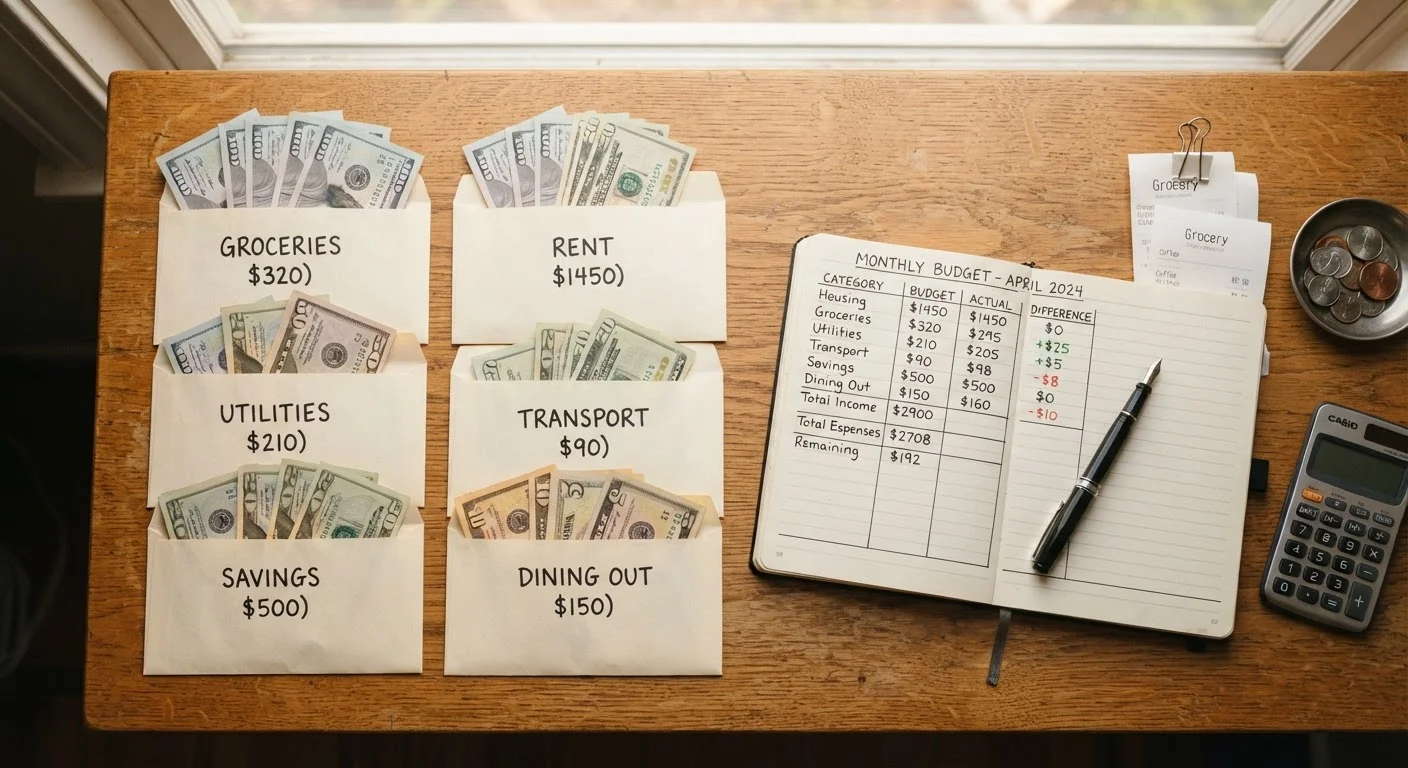
Option A
Envelope Budgeting
The tactile, cash-first system for hands-on spenders.
Best for: People who overspend because they lose track of category totals and benefit from physical limits on their money.
Option B
Zero-Based Budgeting
The comprehensive, plan-every-dollar approach for detail-oriented budgeters.
Best for: People who want comprehensive control over every dollar, including savings and debt payoff, using a written or digital plan.
How Each System Actually Works
Both envelope budgeting and zero-based budgeting (ZBB) are intentional spending frameworks - meaning you decide where money goes before you spend it, rather than reviewing the damage after the month ends. That shared principle is where the similarity largely ends.
Envelope budgeting divides your take-home income into labeled spending categories - groceries, gas, entertainment, clothing - and allocates a set cash amount to each. Traditionally this meant physical envelopes stuffed with cash. When an envelope runs out, spending in that category stops until the next funding period. Digital versions replicate this with virtual envelopes in budgeting apps, so debit card users can adopt the same logic without handling cash. The system is deliberately narrow: it focuses on controlling discretionary spending categories, not necessarily on accounting for every financial obligation.
Zero-based budgeting takes a wider view. You start with your total monthly income and assign every single dollar to a category - bills, groceries, rent, savings, emergency fund contributions, debt minimum payments, and so on - until income minus all assigned categories equals zero. "Zero" does not mean you spend everything; it means no dollar is left unassigned. A dollar sitting in a savings account was deliberately sent there as part of the plan. The budget is rebuilt each month from scratch, which forces regular re-evaluation of spending priorities.
Understanding why overspending happens in the first place can help you choose the structure that counters your specific tendencies.
| Criterion | Envelope Budgeting | Zero-Based Budgeting |
|---|---|---|
| Core concept | Cash caps per spending category | Every dollar assigned a specific job |
| Setup time (monthly) | Low - set amounts, fund envelopes | Moderate - rebuild full plan each month |
| Handles savings goals | Only if you create a savings envelope | Built into the plan by design |
| Works for digital spenders | Only with a digital envelope app | Yes - spreadsheet or app friendly |
| Handles irregular income | Challenging without adjustment | Adaptable - rebuilt monthly from scratch |
| Tracks all expenses | Discretionary categories only | All income and all obligations |
| Learning curve | Very low | Moderate |
Practical Strengths and Real Limitations
Envelope budgeting's greatest strength is its friction-based simplicity. The physical or visual limit of an envelope interrupts the impulse to overspend in a way that a bank balance never quite does - seeing $40 left in a grocery envelope registers more viscerally than reading an account total. The system also requires very little ongoing maintenance once categories and amounts are set. Its limitations are equally clear: it does not naturally account for savings goals, annual expenses, or debt strategy unless you deliberately create envelopes for those items. It also becomes awkward when most of your spending is digital or subscription-based.
Zero-based budgeting demands more upfront effort. Building the monthly plan - especially the first time - can take 30 to 60 minutes. Irregular income earners face the additional challenge of estimating a baseline before the plan can be built. But that rigor pays off: because every expense is listed, irregular costs like car maintenance, medical copays, or annual subscriptions are less likely to blindside you. Many households also find that simply naming every dollar's destination surfaces spending habits they had not previously noticed. For additional strategies on keeping discretionary costs down once your budget is built, see practical approaches to spending less without feeling deprived.
Choosing the Right System for Your Situation
Neither method is universally superior - the right choice depends on your financial complexity, your habits, and how much structure you find motivating versus stifling.
Envelope budgeting tends to work well for households whose main challenge is discretionary overspending - dining, shopping, entertainment - and who want a system they can explain to a partner or teenager in under five minutes. It also suits people who are starting their first real budget and need an approachable entry point. If that describes you, a straightforward savings foundation is the natural next step: a first-timer's guide to building a savings habit covers how to grow from basic spending control into consistent saving.
Zero-based budgeting fits households juggling multiple financial priorities simultaneously - paying down debt, building an emergency fund, managing irregular income, and covering monthly bills - where a high-level overview is not sufficient. If market news or economic uncertainty tends to trigger reactive spending decisions in your household, a written zero-based plan can serve as an anchor. The article on staying grounded when market headlines create budget anxiety explores how a firm budget structure helps reduce financially reactive behavior.
Some households combine elements of both: a zero-based plan for the full financial picture, with envelope-style limits applied specifically to the discretionary categories where they have the most trouble. That hybrid approach is not a compromise - it is a practical adaptation to how real spending actually works.
This article is for informational and educational purposes only and does not constitute financial advice. Individual financial situations vary - consider consulting a qualified financial professional before making significant changes to your budgeting approach.
The content on this site is provided for informational purposes only and should not be considered a substitute for professional advice. While we strive to provide accurate and up-to-date information, we make no guarantees regarding its completeness or accuracy. Always consult a qualified professional for advice specific to your circumstances before making any decisions.