

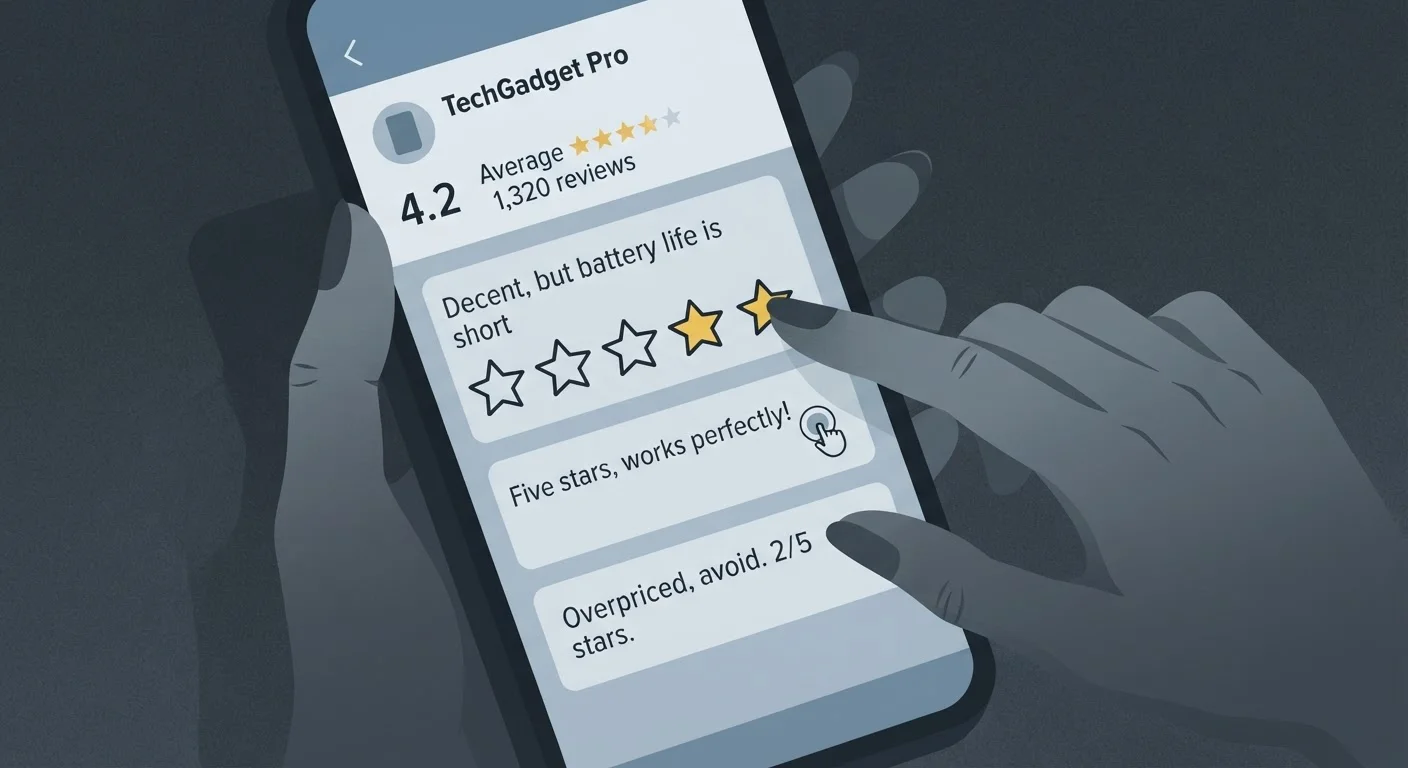
The Three Core Manipulation Tactics
Review manipulation isn't a single trick - it's a toolkit. Three tactics account for the majority of what researchers and regulators have documented.
Incentivized reviews are the most familiar. A seller offers a free product, discount, or payment in exchange for a review. Even when reviewers intend to be honest, research in behavioral economics consistently shows that people who receive something of value rate products more favorably than unprompted buyers. The FTC mandates disclosure, but enforcement is patchy and many incentivized reviews never carry any label.
Review gating is subtler. A seller contacts customers after purchase and asks how satisfied they are. Happy customers get directed to a public review platform. Unhappy customers get directed to a private feedback form - where their criticism is absorbed internally and never becomes public. The result is a skewed public rating that reflects only the satisfied segment of the buyer pool.
Brushing schemes operate differently again. A seller obtains real consumers' names and addresses - often from data leaks or purchased lists - ships cheap, unordered items to those addresses, and then posts fake glowing reviews under accounts that show as "verified purchasers." The consumer gets a mystery package; the seller gets artificial credibility. The FTC and the BBB have both issued consumer alerts about this practice.
Each tactic exploits a different vulnerability in how review systems are designed. Understanding the mechanics, as explained in what separates a credible review from a manipulated one, is the first step toward reading ratings more accurately.
Why Platforms Struggle to Police This
Detection is genuinely hard. Platforms process millions of reviews daily, and distinguishing manipulation from legitimate activity requires more than keyword filters.
The Arms Race Between Platforms and Manipulators
Coordinated manipulation often mimics authentic behavior precisely because bad actors study platform detection methods and adapt. A review farm might introduce deliberate typos, vary posting times, and use residential IP addresses to appear organic. Behavioral signals that flag one generation of manipulation become obsolete when tactics evolve. This is why detection tools require continuous retraining rather than a one-time solution.
Coordinated manipulation often mimics authentic behavior precisely because bad actors study platform detection methods and adapt. A review farm might introduce deliberate typos, vary posting times, and use residential IP addresses to appear organic. Behavioral signals that flag one generation of manipulation become obsolete when tactics evolve.
There's also a structural tension: aggressive automated removal risks deleting real reviews, which damages trust with legitimate buyers and sellers. Over-enforcement generates complaints and legal exposure. Under-enforcement lets manipulation persist. Platforms are caught in an asymmetric fight - defenders must be right almost all the time, while manipulators only need to succeed often enough to be profitable.
Regulatory pressure is increasing. The FTC finalized a rule in 2024 targeting fake and incentivized reviews more explicitly, including prohibitions on insider reviews and review suppression. Whether enforcement keeps pace with the scale of the problem remains an open question.
This is part of why review volume alone is a poor proxy for product quality. A high count of reviews can reflect a genuine market leader - or a well-funded manipulation campaign.
What Shoppers Can Do With This Knowledge
Awareness of how manipulation works changes how you should read reviews, not just whether to trust them.
Look at the distribution of ratings, not just the average. A product with 4,000 five-star reviews and almost no two- or three-star ratings has an implausible distribution - real buyer pools almost always produce some spread. Natural review distributions tend to cluster around four stars with a visible tail of lower ratings.
Check the text quality. Manipulated reviews often share generic phrasing, unusually formal language, or suspiciously similar sentence structures across different accounts. Authentic reviews tend to be specific: they name features, describe use cases, and occasionally mention product flaws.
Consider the platform itself. Not all review sites apply the same standards or conflict-of-interest policies. Questions worth asking before trusting any review platform include how the site funds itself, whether it accepts products from brands it covers, and whether its methodology is published.
Third-party browser extensions that analyze review patterns can also surface anomalies - unusual spikes in posting dates, concentrations of new reviewer accounts, and other signals that aggregate data makes visible but individual reading does not.
This article is for informational purposes only. Regulatory rules and platform policies change over time; verify current requirements with official sources such as the FTC website before acting on compliance-related information.
Frequently Asked Questions
Review gating is the practice of filtering customers before asking for reviews - only inviting those who report positive experiences to leave public feedback. Most major review platforms explicitly prohibit it in their terms of service, and the FTC has indicated it can constitute a deceptive practice. Sellers who use it may face account penalties or regulatory action.
A brushing scam occurs when a seller ships unsolicited packages to real people whose address information they have obtained, then uses those addresses to post fake verified-purchase reviews. The recipient didn't order anything - they just receive a random package. If you get an unexpected shipment, your data may have been used in one of these schemes.
Platforms use machine learning, behavioral signals, and network analysis to flag suspicious reviews, but detection is an ongoing arms race. Review farms and coordinated manipulation rings continuously adapt their tactics to mimic authentic behavior, making automated detection imperfect and resource-intensive.
Not always, but they must be clearly disclosed. The FTC requires that any material connection between a reviewer and a seller - including free products or payment - be transparently stated. A disclosed incentivized review is legally permissible; an undisclosed one is not.
Look for sudden spikes in review volume, an unusual concentration of five-star ratings with vague or generic language, and a lack of verified purchase badges. Third-party tools can analyze review patterns for you. Our guide on <a href="/smart-shopping/consumer-basics/trusting-online-reviews-signals-that-separate-genuine-feedback-from-noise">spotting genuine reviews versus noise</a> covers specific signals to watch for.
No. Categories with high purchase frequency, thin profit margins, and many competing sellers - such as consumer electronics accessories, supplements, and household goods - tend to see higher rates of manipulation. Higher-consideration purchases like appliances or vehicles are not immune, but the economics of manipulation are less favorable.
The content on this site is provided for informational purposes only and should not be considered a substitute for professional advice. While we strive to provide accurate and up-to-date information, we make no guarantees regarding its completeness or accuracy. Always consult a qualified professional for advice specific to your circumstances before making any decisions.