

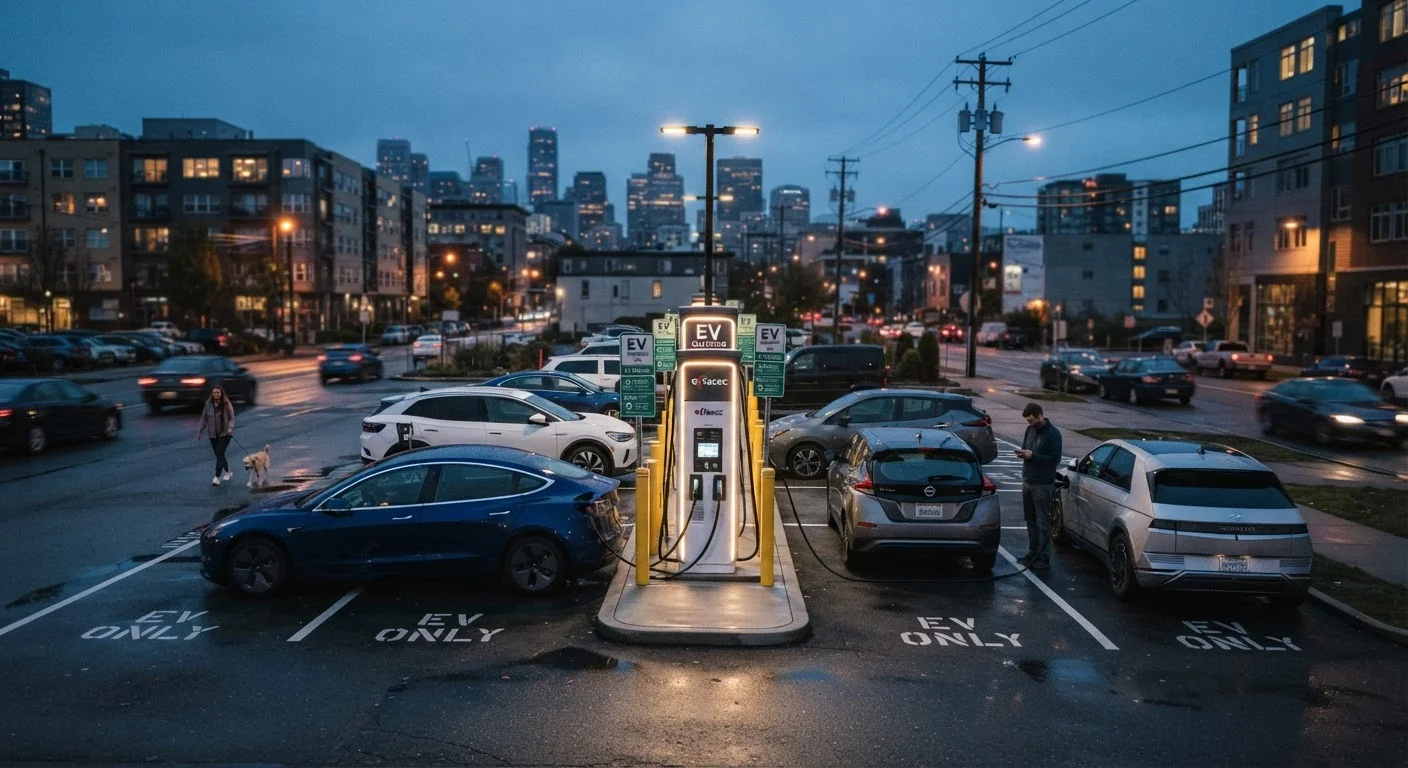
Why Charging Infrastructure Hasn't Kept Up
Electric vehicle sales in the United States have grown substantially over the past several years, yet the public charging network has not expanded at a comparable pace. The reasons are structural. Installing fast chargers requires utility coordination, grid upgrades in some locations, permitting, land agreements, and significant capital investment - all of which take time even when funding is available.
Private charging networks have concentrated stations where return on investment is clearest: busy highway corridors, urban centers, and affluent suburbs. That leaves lower-density communities, older urban neighborhoods, and rural stretches with thin or no coverage. For drivers without home charging access - renters, those in multi-unit housing, and workers without workplace chargers - the public network isn't a supplement. It's the whole system.
Home Charging Is the Baseline - Not the Norm for Everyone
Industry surveys consistently show that around 80% of EV charging happens at home. This statistic can make the public charging gap seem less urgent than it is. For the roughly one in five EV drivers without reliable home charging - and for many prospective buyers evaluating whether an EV is practical - the public network's quality is the deciding factor, not a secondary concern.
The Reliability Problem Is Separate From Coverage
Even where public chargers exist, they don't always work. A 2023 study by J.D. Power found that EV drivers reported problems with public charging equipment at notably high rates, including stations that were out of service, had payment failures, or delivered slower-than-rated speeds. A non-functioning charger at an isolated location isn't just inconvenient - for a driver on a long trip with a low battery, it's a serious problem.
Station reliability varies widely by network operator and location. Chargers installed more recently and those with active remote monitoring tend to perform better. Older stations on legacy networks can sit broken for days or weeks before being repaired. This inconsistency shapes how EV owners plan trips and which networks they trust - and it's a significant factor in how prospective buyers evaluate the switch.
160,000+
Public EV charging ports in the U.S.
According to the U.S. Department of Energy's Alternative Fuels Station Locator, as of 2024.
~21%
Share of U.S. EV owners without home charging access
Estimates vary, but surveys consistently find a significant minority of EV drivers relying primarily on public or workplace charging.
$7.5B
Federal EV charging infrastructure investment
Allocated through the Infrastructure Investment and Jobs Act of 2021 for national EV charging buildout.
~1 in 5
Public chargers found non-functional in audits
A 2023 study of Bay Area chargers found roughly 23% non-operational on a given visit, highlighting reliability concerns.
Who Feels the Gap Most Acutely
The public charging gap doesn't affect all drivers equally. Homeowners with garages or driveways can install Level 2 chargers and handle the vast majority of charging needs at home, using public fast chargers only on road trips. For these drivers, the gap is noticeable but manageable.
Renters, urban drivers without dedicated parking, and lower-income households face a different reality. They depend on publicly available chargers for routine charging - and price, proximity, and reliability all become daily concerns rather than occasional inconveniences. Understanding this distinction matters when evaluating EV ownership as a practical option. For a broader look at how urban car ownership comes with its own pressures, see our coverage of city driving trade-offs.
Geography also plays a significant role. Drivers in California, the Northeast, and parts of the Pacific Northwest have access to denser networks. Drivers in the interior South, rural Midwest, and mountain West often encounter long stretches with no fast-charging option at all.
What the Federal Buildout Actually Looks Like
The $7.5 billion in EV charging funding from the 2021 infrastructure law represents the largest federal investment in charging infrastructure in U.S. history. States have submitted plans and begun contracting, but physical installation takes time. Requirements that stations be spaced no more than 50 miles apart on designated corridors are intended to address the long-distance travel gap specifically.
Critics and advocates have noted that the buildout has moved more slowly than originally hoped, with permitting, utility interconnection queues, and contractor availability all cited as bottlenecks. The funding prioritizes highway corridors, which helps road-trippers but does less for urban renters or rural residents who need chargers in neighborhoods and town centers, not just along interstates.
If you're weighing an EV purchase as part of a broader vehicle decision, the vehicle buying hub offers general guidance on navigating that process. And for ongoing ownership considerations, the vehicle ownership hub covers practical topics relevant to EV and traditional vehicle drivers alike.
A homeowner in suburban Denver installs a Level 2 charger in their garage and charges overnight. They use public fast chargers only on ski-season road trips to mountain towns.
A renter in a Chicago apartment building has no access to building charging and relies entirely on nearby public Level 2 chargers at a city parking garage two blocks away.
A driver in rural Mississippi plans a 300-mile trip and finds only one DC fast charger along the route, located at a single truck stop - with no backup option within 80 miles.
A driver attempts to use a public fast charger at a shopping center in a mid-size city, only to find two of the four ports are broken and a third is occupied with no estimated wait time displayed.
Frequently Asked Questions
As of recent federal data, the U.S. had over 60,000 public charging stations with more than 160,000 individual charging ports. However, the distribution is heavily concentrated in coastal states and urban centers, leaving many regions underserved.
It's a real challenge. Most EV charging happens at home using a standard outlet or installed Level 2 charger, but renters and apartment residents often lack access to dedicated charging. This makes proximity to reliable public charging stations especially important for this group.
Charger reliability is an ongoing industry problem. Older stations often lack remote monitoring or consistent maintenance contracts. Studies have documented failure rates at some public charging networks that significantly exceed what drivers encounter at gas stations.
Yes. The Infrastructure Investment and Jobs Act allocated $7.5 billion specifically for EV charging infrastructure. Funds are distributed through states, with requirements that stations be placed along designated highway corridors, though deployment has been slower than initially projected.
Generally, yes. Rural areas have lower charger density and longer distances between stations, making range anxiety a more practical concern. Some rural drivers with home charging setups manage well for local use, but long-distance rural travel remains a gap in the network.
The content on this site is provided for informational purposes only and should not be considered a substitute for professional advice. While we strive to provide accurate and up-to-date information, we make no guarantees regarding its completeness or accuracy. Always consult a qualified professional for advice specific to your circumstances before making any decisions.