

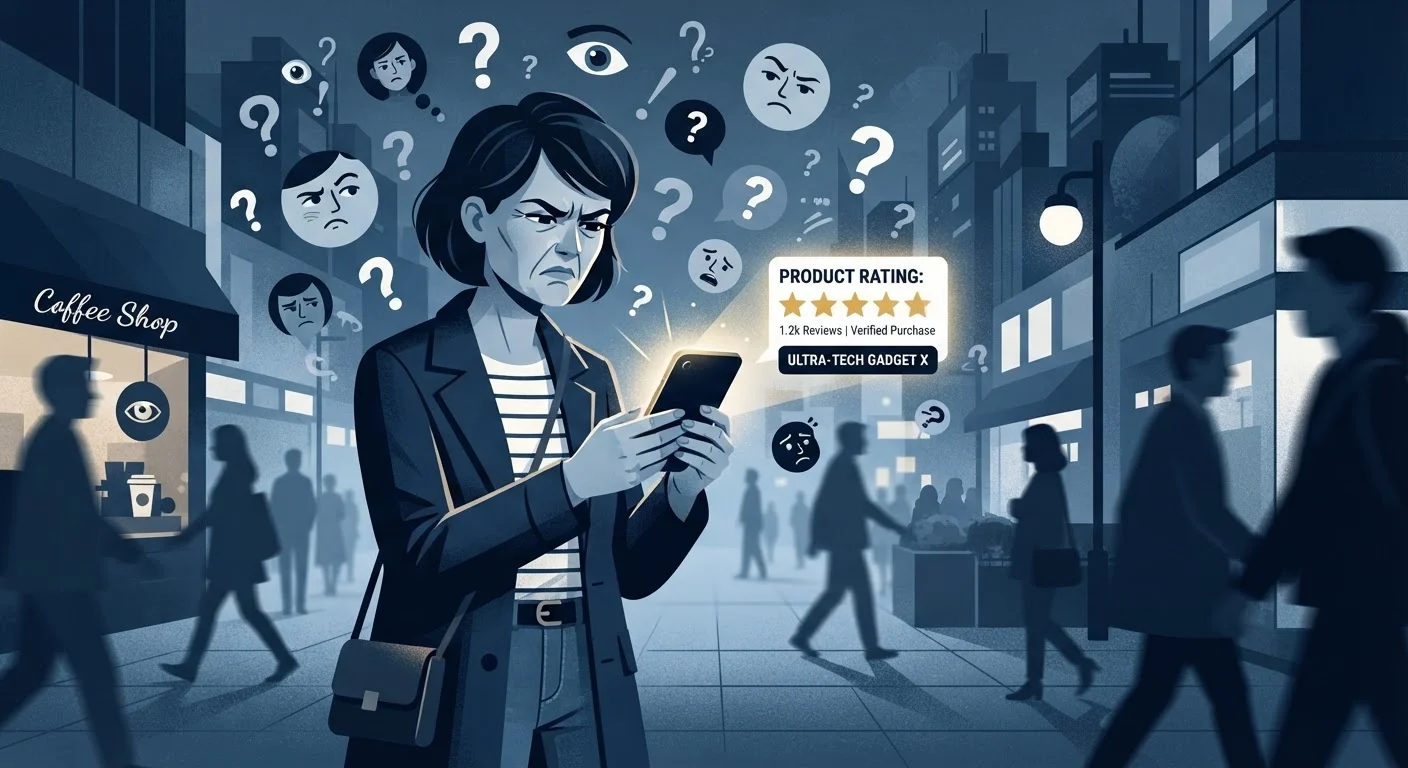
From Trusted Signal to Suspected Noise
Online reviews were once considered one of the internet's genuine democratizing forces. Before platforms aggregated star ratings, most consumers relied on word-of-mouth or paid advertising - both of which had obvious limitations. The promise of peer feedback at scale seemed like a breakthrough for everyday buyers.
That promise has frayed considerably. A combination of commercial pressure on sellers, the low cost of generating fake feedback, and insufficient platform enforcement has produced an environment where a five-star average can mean almost anything. Surveys conducted in the early 2020s consistently found that a majority of American consumers suspected they had encountered fake reviews, and a meaningful share reported changing how much they trusted ratings as a result.
The skeptical shopper didn't emerge from cynicism alone - they emerged from experience. Shoppers who purchased highly rated products and found them defective, or who noticed clusters of suspiciously enthusiastic reviews, learned to distrust the display before the product. That learned skepticism is now shaping how an entire generation approaches online purchasing decisions. For deeper context on what authentic feedback actually looks like, see what separates a credible review from a padded one.
The Mechanics Behind the Collapse
Understanding why trust collapsed requires understanding the incentive structure that warped the review ecosystem. Sellers on competitive marketplaces discovered early that higher ratings translated directly into more sales. This created powerful motivation to manipulate ratings - and an entire industry emerged to meet that demand.
Common tactics include "review farms" where paid writers produce bulk five-star feedback, "incentivized reviews" where customers receive free products or discounts in exchange for positive ratings, and increasingly sophisticated bot networks that generate plausible-looking accounts. Platforms have invested in detection systems, but the arms race between manipulation and enforcement has not resolved cleanly in consumers' favor.
82%
Consumers who read online reviews for local businesses
According to BrightLocal's annual Local Consumer Review Survey, the vast majority of consumers consult reviews before engaging with a business, underscoring how much is at stake when those reviews are manipulated.
~30-40%
Estimated share of online reviews that may be fake
Various analyses by independent researchers and consumer advocacy groups have estimated that a significant minority of reviews on major retail platforms show signs of inauthenticity, though precise figures vary by platform and category.
$700K+
Maximum FTC penalty per fake review violation
Following updated FTC enforcement guidance on fake reviews and testimonials, companies found in violation face civil penalties of up to several hundred thousand dollars per violation, signaling increased regulatory seriousness.
Regulatory attention has increased. The Federal Trade Commission has clarified that undisclosed incentivized reviews violate truth-in-advertising standards and has pursued enforcement actions against companies that failed to meet disclosure requirements. But regulation operates more slowly than market behavior, and by the time enforcement catches up, new manipulation methods have often already spread. Readers who want to recognize specific manipulation patterns can explore how to identify fake reviews across major retail sites.
Where Skeptical Shoppers Are Turning Instead
The decline of trust in aggregate ratings has not made consumers passive - it has made them more resourceful. Several alternative signals have gained credibility as star ratings have lost it.
Personal networks: Recommendations from friends, family, and trusted online communities carry significant weight precisely because the social relationship creates accountability. An anonymous five-star review has no such accountability.
Independent editorial outlets: Publications with disclosed methodology, no affiliate relationships with the products they review, and a track record of critical assessments have grown in perceived credibility. Readers have become more attentive to how a review site funds itself - a site that earns commissions from the products it recommends has a structural conflict of interest. Questions worth asking before trusting any review platform can help readers assess independence.
Critical review patterns: Savvy shoppers now often read the one- and two-star reviews first. The texture of critical feedback - whether it describes specific failure modes or reads as coordinated sabotage - reveals a great deal about a product's real-world performance. Signals that separate genuine reviews from noise offers a structured approach to this kind of reading.
This same skepticism applies beyond product categories. Whether evaluating a car dealership's reputation or a travel accommodation's rating, the habits that make a better product shopper translate directly - see the product reviews hub for broader guidance across consumer categories.
What This Means for Consumers Going Forward
The skeptical shopper is not a temporary phenomenon - it is likely the new baseline. As awareness of review manipulation has become mainstream, and as regulatory and press scrutiny has increased, consumers are unlikely to revert to uncritical trust in aggregate ratings.
This creates both a challenge and an opportunity. The challenge is that evaluating purchases now requires more active effort - cross-referencing sources, reading critically, and understanding how review platforms are structured. The opportunity is that consumers who develop these habits are meaningfully better protected against manipulation than those who don't.
The long-term pressure this creates on platforms and sellers is also worth watching. Marketplaces that invest credibly in review integrity - verified purchases, transparent moderation, meaningful consequences for manipulation - may differentiate themselves as trust becomes a competitive variable rather than an assumed default.
This article is for informational purposes only. Consumers should verify claims and conduct their own research before making purchasing decisions.
Frequently Asked Questions
The commercial value of high ratings created strong incentives for sellers to manufacture positive reviews through bots, paid reviewers, and incentivized programs. As these tactics scaled across major platforms, the signal-to-noise ratio deteriorated. Regulators and platforms have responded, but enforcement lags behind the pace of manipulation.
Not all ratings are equally suspect, but they vary widely in reliability. Verified-purchase labels, review volume, rating distribution, and the presence of detailed critical reviews are all signals worth examining. No single platform guarantees authenticity across all listings.
Many consumers now cross-reference independent editorial outlets, seek recommendations from friends and online communities, and look for patterns in critical reviews rather than overall scores. Long-form, methodology-transparent reviews tend to be more reliable than aggregate ratings alone.
Yes. The Federal Trade Commission has pursued enforcement actions against companies that used fake or undisclosed paid reviews. The FTC's updated guidelines require clear disclosure when reviews are incentivized, and violations can result in significant financial penalties.
Look for specificity - genuine reviews tend to mention particular product features, compare the item to alternatives, or describe a concrete use case. Generic five-star praise with little detail, clusters of reviews posted within a short window, and identical phrasing across multiple reviews are common red flags.
Yes, manipulated reviews appear across virtually every consumer category, including auto dealerships, travel accommodations, and service providers. The same critical reading habits that apply to product reviews are worth applying whenever star ratings influence a significant purchasing decision.
The content on this site is provided for informational purposes only and should not be considered a substitute for professional advice. While we strive to provide accurate and up-to-date information, we make no guarantees regarding its completeness or accuracy. Always consult a qualified professional for advice specific to your circumstances before making any decisions.