

Why This Distinction Matters in Everyday Life
You've almost certainly heard the phrase "correlation is not causation," but it's far easier to say than to apply when a headline claims a new habit protects your health, or when a product review site suggests its highest-rated items are reliably better. The confusion between the two is one of the most consequential reasoning errors ordinary people encounter - and it shows up in news, advertising, policy debates, and casual conversation every single day.
Understanding this idea isn't reserved for statisticians. It's a practical thinking tool that helps you ask sharper questions, resist manipulation, and make smarter decisions. Think of it as one building block in the broader skill of spotting flawed reasoning - something everyday logical fallacies article explores in depth.
Myth
If two things consistently happen together, one must be causing the other.
Fact
Consistent co-occurrence is evidence of correlation only. Establishing causation requires ruling out confounders and, ideally, a controlled experimental design.
Correlation measures the degree to which two variables move in tandem. Causation means one variable directly produces a change in the other. The jump from the first to the second is not automatic - it requires additional evidence. Historical data is full of absurd but statistically real correlations: per capita cheese consumption has tracked certain accidental death rates for years. Nobody argues cheese is lethal. The correlation exists by chance, or because of shared trends unrelated to each other.
Myth
A very strong correlation - like 0.9 or higher - is basically proof of causation.
Fact
Correlation strength tells you how tightly two variables move together, not why. A 0.95 correlation can still be entirely spurious.
The strength of a correlation coefficient describes the reliability of the pattern, not its origin. Two variables can correlate almost perfectly because they're both responding to a third variable, because of a coincidental shared trend over time, or simply because of data dredging - the practice of testing so many variable pairs that some strong correlations emerge by pure statistical chance. Strength narrows the field of plausible explanations, but it doesn't close it.
Myth
If A consistently comes before B, then A must be causing B.
Fact
Temporal precedence - A happening before B - is a necessary condition for causation, but it is not sufficient on its own.
Roosters crow before sunrise. Sunrise is not caused by roosters. This illustrates that sequence alone proves nothing. In research terms, establishing that A precedes B is one of several criteria for causation, alongside ruling out confounders and demonstrating a plausible mechanism. Many health myths persist because a behavior happens to precede an outcome without actually driving it - the real driver is often something else entirely that also preceded B.
Myth
Scientists have proven that X causes Y, so the study I read must be reliable.
Fact
A single study rarely 'proves' causation. Scientific consensus builds through replication, varied methodologies, and peer review over time.
News coverage frequently frames individual studies as definitive when they are, at best, one step in a longer process. A single observational study showing that people who do X have lower rates of Y is hypothesis-generating - it tells researchers where to look next, not what to conclude now. When you see a dramatic health or behavioral claim, look for whether it's based on a randomized trial, whether it's been replicated, and whether the broader research community treats it as settled.
The Hidden Variable Problem
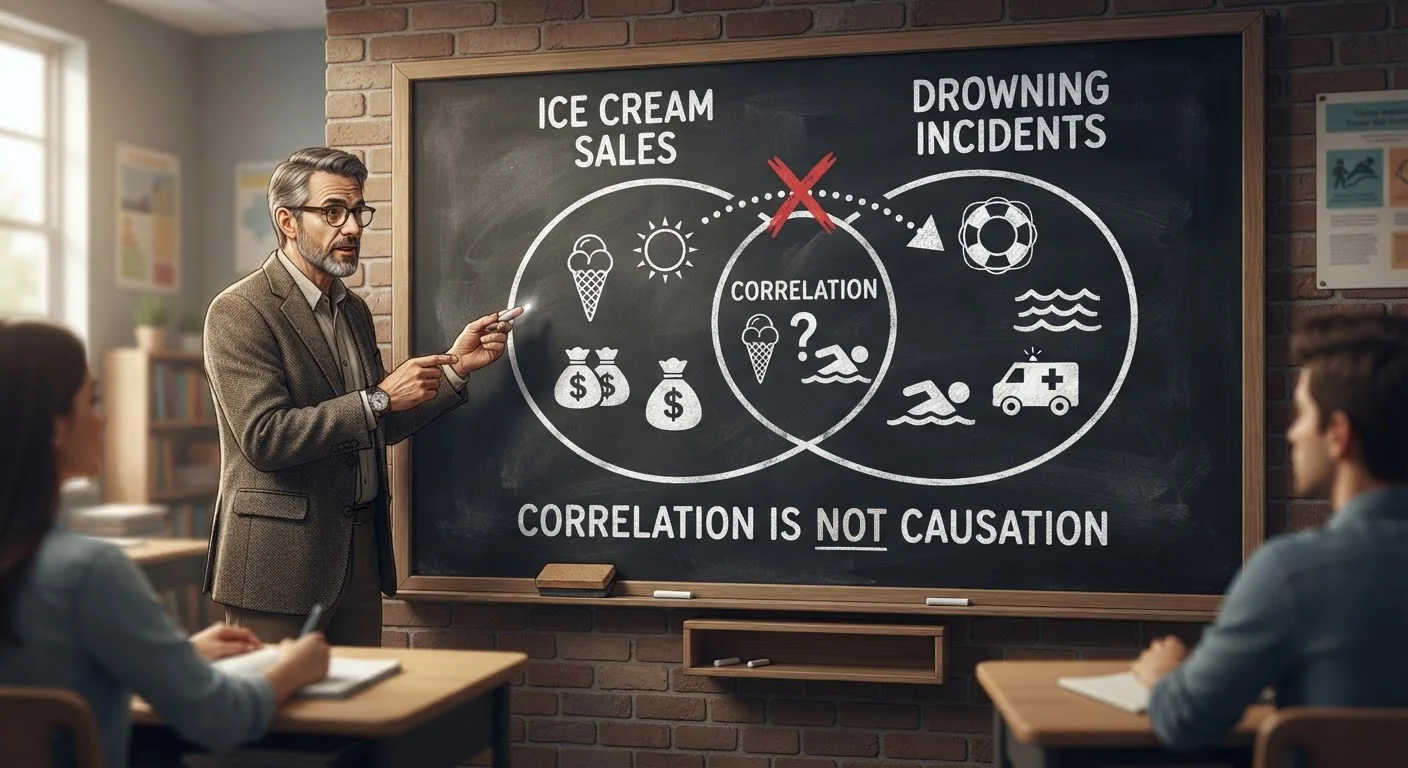
One of the main reasons correlations mislead us is the presence of a confounding variable - a third factor that independently influences both of the things we're comparing. Ice cream sales and drowning rates both rise in summer, not because one causes the other, but because hot weather drives both. Remove summer, and the correlation largely disappears.
Confounders are everywhere in consumer research too. Products with the most reviews often appear superior, but review volume is frequently driven by marketing spend or platform placement - not actual quality. The real driver (visibility) is hiding behind the apparent link between review count and perceived reliability.
Over 80%
Of nutrition headlines oversimplify study findings
Researchers at the Harvard T.H. Chan School of Public Health have noted that media coverage routinely overstates causal conclusions from observational nutrition studies.
1 in 20
Chance a false correlation appears significant
At the standard 0.05 significance threshold, one in every twenty variable comparisons will appear statistically significant by chance alone - a core reason data dredging produces spurious results.
Similarly, economic data is routinely misread because of confounders. When two economic trends move in the same direction, it's tempting to blame one for the other - but myths about rising prices often stem from exactly this kind of thinking, where a visible event gets credited for a change that was already underway for separate structural reasons.
How to Think More Clearly About Cause and Effect
Researchers use several specific tools to move from correlation toward genuine causal understanding. Randomized controlled trials (RCTs) randomly assign participants to conditions, which distributes confounders evenly and isolates the variable being tested. Natural experiments exploit real-world events - like a policy change in one state but not another - to approximate that control. Longitudinal studies track the same individuals over time to establish whether one thing actually precedes the other.
As a reader or consumer, you rarely have access to these methods directly. But you can ask useful proxy questions: Did the researchers control for obvious third variables? Is this an experiment or an observation? Does the claimed cause actually come before the effect? Has this finding been replicated in different populations?
Be Especially Cautious with Health and Financial Claims
Claims that a supplement, habit, or investment strategy 'causes' better outcomes are frequently based on observational data alone. Before acting on such claims, look for controlled trial evidence and consult qualified professionals. Correlation-based reasoning in high-stakes domains - health decisions, financial choices - can lead to real harm if treated as causal proof.
Developing the habit of asking these questions is one of the most accessible and immediately useful skills a lifelong learner can build. You don't need a statistics degree - you need a reliable checklist of the right questions to ask before accepting a claimed connection as a cause.
The content on this site is provided for informational purposes only and should not be considered a substitute for professional advice. While we strive to provide accurate and up-to-date information, we make no guarantees regarding its completeness or accuracy. Always consult a qualified professional for advice specific to your circumstances before making any decisions.