

Start here
What Is Compound Interest, Really?
Next
How Compounding Actually Works
Then
Where You Encounter Compound Interest in Everyday Life
Going deeper
The One Variable That Changes Everything: Time
Apply it
How to Use This Knowledge Right Now
What Is Compound Interest, Really?
Compound interest is simply this: you earn interest on your interest, not just on the money you originally put in. That one sentence contains everything important about the concept.
Here's an everyday analogy. Imagine you lend a friend $100 and they pay you back $110 at the end of the year - that extra $10 is basic interest. Now imagine that next year, instead of starting fresh with $100, you start with $110. Your interest in year two is calculated on the full $110. The year after that, it's calculated on whatever $110 has grown into. Each year, the base you're earning on gets a little bigger, because your past earnings are now part of it.
That's compounding. It doesn't require special math skills to grasp - it's a pattern of growth that builds on itself.
Principal
The original amount of money you deposited, invested, or borrowed - before any interest is added.
Interest rate
The percentage of the principal charged or earned over a specific time period, typically expressed annually.
Compounding frequency
How often interest is calculated and added to your balance - daily, monthly, quarterly, or annually. More frequent compounding means faster growth.
APY (Annual Percentage Yield)
The real rate of return on a savings account for one year, taking compounding frequency into account. Useful for comparing accounts accurately.
Capitalization
When unpaid interest on a loan is added to the loan's principal balance, so future interest is then calculated on the larger amount.
Exponential growth
Growth that accelerates over time because each period's increase is calculated on a larger base than the last - the pattern compounding creates.
How Compounding Actually Works
The mechanics involve just three elements: a principal (your starting amount), an interest rate (the percentage earned or owed per period), and time (how many periods pass). Compounding frequency - how often interest is calculated and added - also matters.
Consider a simple example without any intimidating formulas. If you deposit $1,000 in a savings account earning 5% interest annually:
- After year one, you have $1,050 ($1,000 + $50 interest).
- After year two, you earn 5% on $1,050 - that's $52.50, bringing your total to $1,102.50.
- After year three, you earn 5% on $1,102.50, and so on.
Notice how the interest amount grows each year - $50, then $52.50, then a little more. You didn't add any new money. The growth is coming from interest earning interest. Over decades, this escalating pattern is what makes compounding feel almost like magic, even though the underlying logic is completely straightforward.
Where You Encounter Compound Interest in Everyday Life
Compound interest shows up in more places than most people realize - and it doesn't always work in your favor.
When it works for you
- High-yield savings accounts: Banks that compound interest daily or monthly grow your balance faster than those that compound annually.
- Retirement accounts (401(k), IRA): Investment gains that are reinvested rather than withdrawn create a compounding-like effect over decades.
- Certificates of deposit (CDs): A fixed-rate CD compounds your interest over the term of the deposit.
When it works against you
- Credit card balances: Many cards compound interest daily on any unpaid balance. Carrying a balance month to month can cause debt to grow faster than you expect.
- Personal loans and student loans: Depending on loan terms, unpaid interest may capitalize - meaning it gets added to your principal, and you then owe interest on that larger amount.
Understanding which side of compounding you're on at any given moment is a practical financial literacy skill with real consequences.
The One Variable That Changes Everything: Time
Of all the factors involved in compound interest, time is the one most worth understanding - and the one most people underestimate.
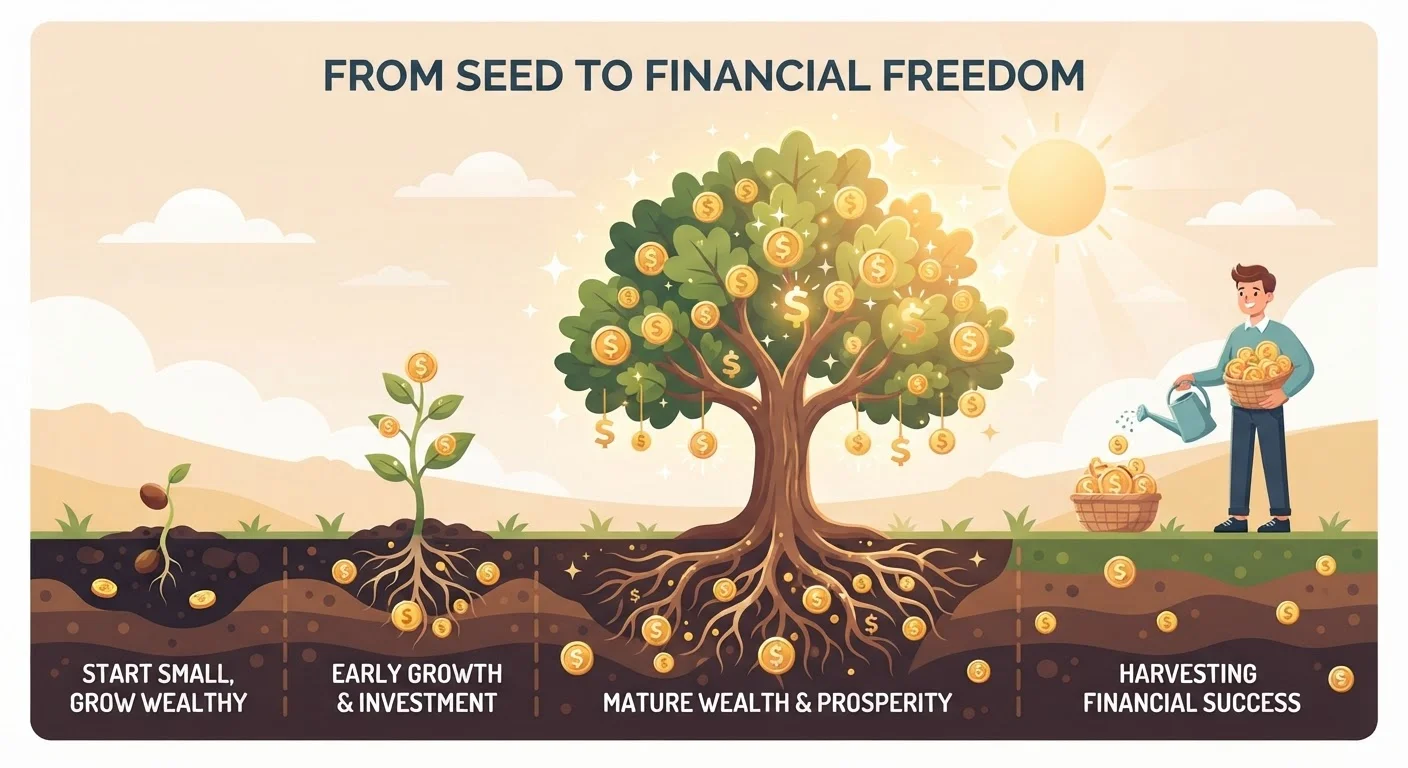
The reason is that compounding is exponential, not linear. In the early years, growth looks modest. But each period, the base grows a little larger, and the interest calculated on it grows with it. Eventually, the accumulated interest can dwarf the original principal.
Financial educators often illustrate this with a thought experiment: a person who starts contributing to retirement savings at age 25 and stops at 35 can end up with more at retirement than someone who starts at 35 and contributes every year until 65 - simply because of the extra decade of compounding early on. The precise numbers vary depending on rates and contributions, but the directional insight is well-supported: earlier is meaningfully better, even if amounts are small.
Start Small, Start Now
You don't need a large sum to benefit from compounding - you need time. Even modest, regular deposits to a savings or retirement account can grow substantially over decades. The most common regret financial educators hear from adult learners is not starting sooner, not starting with too little.
This also explains why high-interest debt left unpaid is so damaging. Time, which is an ally in savings, becomes an adversary when you're on the wrong side of the interest equation.
How to Use This Knowledge Right Now
Understanding compound interest conceptually is only useful if it changes how you think about financial decisions. Here are some concrete ways this knowledge applies:
- Pay down high-interest debt first. The compounding working against you on credit card debt is often far more powerful than any compounding working for you in a savings account. Prioritizing payoff reduces the base that interest is calculated on.
- Look at APY, not just interest rate. When comparing savings accounts, the Annual Percentage Yield (APY) tells you what you'll actually earn after factoring in compounding frequency. Two accounts with the same stated rate but different compounding schedules will grow at different speeds.
- Contribute consistently, even in small amounts. Because time is the most powerful variable, starting with whatever amount you can manage - and doing so regularly - tends to outperform waiting until you can contribute more.
- Reinvest returns when possible. In investment accounts, choosing to reinvest dividends and gains rather than withdraw them allows compounding to continue working on a growing base.
You don't need to master formulas or become a finance expert. Recognizing compounding when you see it - and positioning yourself on the right side of it - is the practical takeaway that matters most.
This article is for general informational and educational purposes only and does not constitute financial advice. Consult a qualified financial professional before making decisions about savings, investments, or debt management.
Frequently Asked Questions
Simple interest is calculated only on your original principal - the amount you started with. Compound interest is calculated on both the principal and any interest already earned. Over time, this difference becomes very significant in favor of compounding.
Yes, and it can work powerfully against you. When you carry a credit card balance, interest is added to what you owe, and then more interest is charged on that higher balance. This is why high-interest debt can grow quickly even if you're making minimum payments.
Compounding frequency varies by account or loan type. It can occur daily, monthly, quarterly, or annually. More frequent compounding generally means faster growth for savings - and faster accumulation for debt.
No. Even modest, regular contributions to a savings or retirement account can grow substantially over decades. The key ingredients are consistent contributions and sufficient time, not a large starting balance.
APY stands for Annual Percentage Yield. It reflects the real rate of return on a savings account after accounting for how often interest compounds during the year. A higher APY generally means your money grows faster.
Not exactly, but they work similarly. In a savings account, compound interest is a contractual rate. With investments, returns can vary and aren't guaranteed. However, reinvesting investment gains creates a compounding-like effect that builds wealth over time.
The content on this site is provided for informational purposes only and should not be considered a substitute for professional advice. While we strive to provide accurate and up-to-date information, we make no guarantees regarding its completeness or accuracy. Always consult a qualified professional for advice specific to your circumstances before making any decisions.